The cost plan and the operating plan
From a peak burn of USD 280M in fiscal 2022 to under USD 10M in fiscal 2027. Bear sets the cost envelope. The remaining question is whether the company can grow from the smaller base.
Throughout 2021-2022, we collectively optimized everything at Dapper Labs for a land grab at all costs. Every part of the company was built for speed and scale.
The costs were heavy. Since 2022, we have been reducing the cost base, restructuring partner agreements, retiring legacy obligations, and consolidating separate products onto common infrastructure. After completing the changes outlined below, we will have gone from a peak burn of USD 280M in fiscal 2022 to less than USD 10M in fiscal 2027.
We are managing costs to what we are calling the bear case plan ("Bear"). Bear removes USD 10.4M of operating cost relative to the previously approved Board Long Range Plan (LRP) and reduces Flow Foundation disbursements by another USD 3.9M. Every major cost lever is pulled. Flow Foundation support falls to almost zero after a careful transition. All protocol work leaves Dapper's cost base. Peak Money stops operating as a standalone product. Collectibles becomes leaner still.
The Finance-approved Bear composition assumes USD 12 million of revenue next year: USD 10 million from NBA Top Shot and USD 2 million from Disney Pinnacle, with no contribution from NFL ALL DAY or new intellectual property. On these rounded figures, Bear provides approximately 18 months of runway.
The remaining question is whether the company can grow from this smaller base. We believe the answer is clearly yes.
We have spent the last two years turning a collection of bespoke products into a common platform. The current business still loses money, but the underlying machine is much more efficient to operate. Years of direct experience across NBA, NFL, and Disney have taught us how scarcity, collector retention, partner guarantees, and long-lived marketplaces behave. That operating knowledge is one of the strongest assets in the case. If one new title can launch on the shared platform at the cost we now model, the downside improves immediately. If we can repeat the launch without rebuilding the company each time, the business changes.
Finance's cost envelope
The pro forma below is Finance's current integrated view of Bear. It starts with the fiscal 2026 forecast and fiscal 2027 LRP, then applies the revenue downside and cost reductions. This is the financial envelope for the restructuring decisions that follow.
| Circuit breaker | Annual value | Timing |
|---|---|---|
| Collectibles operating expense, 50% reduction | USD 6.0M | Reorg execution begins October 1, 2026 |
| Flow Foundation disbursement, USD 4.0M to USD 0.1M | USD 3.9M | Foundation migrated to L2 by January 1, 2027 |
| Google Cloud, 50% reduction | USD 1.5M | In effect November 1, 2026 |
| Octopus Rodeo wind-down | USD 1.2M | As soon as possible |
| Peak Money wind-down and merger search | — | As soon as possible |
| Total identified | USD 12.6M | All by year end |
The resulting cash position, against the two comparison cases:
| Scenario | Revenue | Fiscal 2027 ending cash |
|---|---|---|
| Base case Long Range Plan | USD 22.1M | USD 0.60M |
| Bear | USD 12.0M | USD 3.67M |
| Bear plus one Medium title | USD 17.0M | USD 5.95M |
Management's implementation changes several labels and timing assumptions carried in Finance's view:
- Bear is the cost envelope, not the revenue goal. The company will manage cost to this downside while working to maximize revenue.
- Flow completes its transition inside Finance's existing USD 7.0M fiscal 2026 envelope. Dapper's annual contribution then falls from the USD 4.0M carried in the fiscal 2027 LRP to USD 0.1M.
- New-protocol funding stops immediately. Dapper provides no further cash or team for protocol development, launches, or token work.
- Google Cloud reaches a USD 1.5M annualized run rate by December 31, 2026. The reduction is not deferred into fiscal 2027.
- Dapper funding for the CryptoKitties and Miquela team ends. An outright shutdown or an independent spinout remains a board question.
- Peak Money becomes Dapper VIP. This is a rebrand using shared capacity, not a customer wind-down or a dedicated new team.
- Collectibles reductions begin immediately. Management commits to Finance's average burn, will scale the team with revenue, and will return with a more specific operating plan.
1. Completing the restructure
The remaining cost decisions have operating consequences. Each one changes what Dapper owns, funds, builds, or stops. Each also has transition work, dependencies, and consequences for the products and customers we intend to keep.
Flow: remove the subsidy, prevent impact on revenue and trust
Dapper's revenue products depend on Flow. Customer assets, ownership history, marketplace activity, and access to our applications all rely on the network continuing to operate as customers expect. That dependence is also a dependence on trust. We have not found a viable way to move these products to another network without asking customers to migrate or reissue assets and creating serious risk to customer trust and revenue.
That is why reducing Dapper's contribution to Flow is not a switch we can flip or an ordinary vendor exit. We have to preserve the network and every customer asset while changing the infrastructure underneath it. A failed or rushed transition would damage the business we are restructuring to protect.
After sustained discussion, collaboration, and technical R&D with the Flow Foundation team, we believe we have found a credible path. The idea Fred Wilson raised was to make Flow to Dapper what Base is to Coinbase: a network that continues to support Dapper's products and retain its identity, but runs on inexpensive, widely supported infrastructure rather than requiring Dapper to fund a large, standalone technology and ecosystem organization.
This is a transition, not a simple upgrade. The final form could remain a Layer 1 network or become a Layer 2 network. Either path requires careful technical design, testing, and execution while the products remain live. The work has been difficult because continuity is the requirement: ownership, asset history, customer access, and application behavior must remain intact throughout the change.
The end-state gives up some infrastructure differentiation. That trade is acceptable for the collectibles business. Flow can retain what commodity technology does not provide: its name, community, history, existing assets, and relationship with the applications that brought users onto the network. The value shifts from proprietary infrastructure toward brand and community.
Dapper's financial commitment is to completing that transition, not to indefinite ecosystem funding. Finance already carries USD 7.0M of Flow Foundation operating expense and disbursements in the fiscal 2026 forecast. The transition must be completed inside that existing full-year envelope, with no incremental transition budget.
The Foundation remains responsible for the network. The transition will be complete by December 31, 2026. Finance's fiscal 2027 LRP carried a USD 4.0M Dapper contribution to the Foundation. After the transition, that contribution falls to USD 0.1M a year, an annual reduction of USD 3.9M.
New protocols
Dapper funding and development for new protocols stop immediately. This is separate from the limited work required to protect continuity on Flow. Dapper will not fund protocol teams, product development, launches, or token work.
Where the Flow Foundation owns the intellectual property, the Foundation decides whether and how to continue it. Any protocol that moves forward must use independent capital and operate outside Dapper's cost base. Dapper has no continuing cash or staffing commitment.
Google Cloud
Google Cloud spend is a direct consequence of the way Dapper built during the land grab. Each licensed product had its own backend and operating stack. That architecture was fast to launch and expensive to maintain. Dapper spent USD 5.26 million on Google Cloud in 2025 and entered 2026 at roughly a USD 5.5 million annual run rate.
The reduction is not a blunt shutdown of infrastructure that supports revenue. The main work is architectural. Atlas replaces the separate NBA, NFL, and Disney backends with one shared platform. That reduces duplicate services, idle capacity, maintenance work, and the incremental infrastructure required to launch another licensed property. Dapper is also resetting its enterprise commitment with Google, but vendor negotiation does not replace the consolidation work.
By August, collective Google Cloud spend had been reduced by roughly half. The remaining target is a USD 1.5 million annualized run rate by December 31, 2026. That becomes the continuing cost base rather than a temporary year-end reduction.
CryptoKitties and Miquela
The cost plan ends Dapper funding for Octopus Rodeo, the team responsible for work on CryptoKitties, Miquela, and related consumer experiments. This removes roughly USD 1.2 million of annual cost. It also means that Dapper will have nobody dedicated to further work on CryptoKitties or Miquela.
The disposition of the team and existing work remains open for board discussion. One path is an outright shutdown. The other is a spinout that lets the team pursue these projects independently with the code and intellectual property, on terms approved by the board. Either path ends Dapper funding.
Peak Money becomes Dapper VIP
Peak Money will not continue as a separate brand or standalone product roadmap. It will become Dapper VIP. For existing customers, this is a rebrand rather than a migration, withdrawal period, or product closure. Their accounts, balances, and access continue under the Dapper brand.
The working consumer-finance capabilities also remain: identity, compliance, fraud controls, the wallet, funding and withdrawal rails, the yield account, and the prize product. They become parts of the Dapper wallet and Dapper VIP rather than a separate company inside Dapper.
The cost boundary is firm. Dapper will not fund new protocols or a separate Peak Money roadmap. Dapper VIP uses the capabilities that already exist and focuses them on Dapper's current customers, beginning with its most active collectors. The membership and card belong to the operating plan; protocol development does not.
The rebrand adds no dedicated team. The existing Dapper organization owns the wallet, membership, card, compliance, and operations as shared work. The program must fit inside that cost base.
The collectibles operating team
Dapper has already reduced the collectibles organization from nearly 100 people at its peak to roughly 35 by June. The April restructuring happened ahead of plan. After the settling period, we saw no measurable decline in shipping cadence, revenue, or the work committed to the board.
That result did not mean we had extra people. Management sequenced the reduction carefully around live revenue and partner commitments. Atlas consolidation, AI tools, code generation, and internal automation absorbed work that had previously required manual effort. The organization kept delivering because we changed how the work was done while we reduced the team.
The next reduction begins immediately. Finance's model assumes that collectibles operating expense falls by roughly half around the end of October. Management is committing to the average burn in that model, not to a fixed headcount or a single reduction date.
The sequence matters. We will remove cost as work is consolidated and roles become unnecessary, rather than cut every function at once. The governing constraint is to minimize the effect on current revenue, partner obligations, and live product operations. Atlas makes this possible by replacing separate product stacks with one shared platform and removing work that previously had to be repeated for each licensed property.
The team will scale with revenue rather than a fixed end-state headcount. Management will return shortly with a specific plan that maps the required functions and capacity to the revenue base.
Taken together, these actions separate what Dapper must preserve from what it can no longer fund. The retained company is built around collectibles on Atlas, the Dapper wallet and VIP program, and shared corporate capabilities. Flow continuity is protected through a transition rather than a permanent subsidy. Everything else leaves the cost base.
2. The operating plan
Cost reduction buys time. It does not create an outcome. The operating plan uses that time in four ways: continue reducing structural cost, launch new properties on the shared collectibles platform, turn Dapper VIP into a paid membership and card program, and expand the top of the funnel through our partners.
A. Continue reducing structural cost
The year-end targets are not the end of the cost work. Every major expense remains under review. The person who owns the spending must also own the revenue or operating result it is meant to produce.
The largest savings depend on engineering and operating changes rather than temporary budget freezes. Google Cloud must remain at the new annualized run rate after the migration. Software and AI tools will continue to consolidate. Marketing spend must have a measurable objective and stop when it does not produce the expected result. Transaction costs, incentives, and product subsidies must remain inside the economics of the activity they support.
New work cannot become pooled overhead. It must fit inside the shared organization, pay for itself, or use independent capital. This is a continuing operating discipline, not another periodic restructuring program.
B. Launch new properties on one shared platform
Dapper Collectibles is a scaled operating business with recognized revenue, valuable partner relationships, a durable core collector economy, and a substantially rebuilt technical platform. It also loses a great deal of money on the fiscal 2026 cost structure. Finance forecasts approximately USD 17.0M of revenue and a (USD 16.0M) operating loss before general and administrative allocation. Finance currently labels that figure "EBITDA before general and administrative allocation." Because that is not a standard definition of EBITDA, the final financial view must define it plainly. The business is marching toward profitability; it has not reached it.
The investment case rests on a transformation in how the company produces and operates collectible titles. The 2021–22 business combined high product revenue with bespoke engineering, large teams, and partner commitments written for a land-grab market. The rebuild consolidated products onto Atlas, reduced people, renegotiated obligations, and created a common operating stack. The next phase aims to spread that fixed platform across a portfolio of new titles while keeping each title’s partner, people, content, and marketing cost attached to its expected return.
The new-title strategy is economically coherent under the available assumptions. A title launched on the shared platform can produce positive contribution before platform and corporate allocation. Continued launches can replace aging revenue cohorts and raise the floor. The economics fail if every title recreates a bespoke team, if guarantees stay flat while revenue declines, or if deals slip and nothing replaces them.
The decay curve comes from our own data
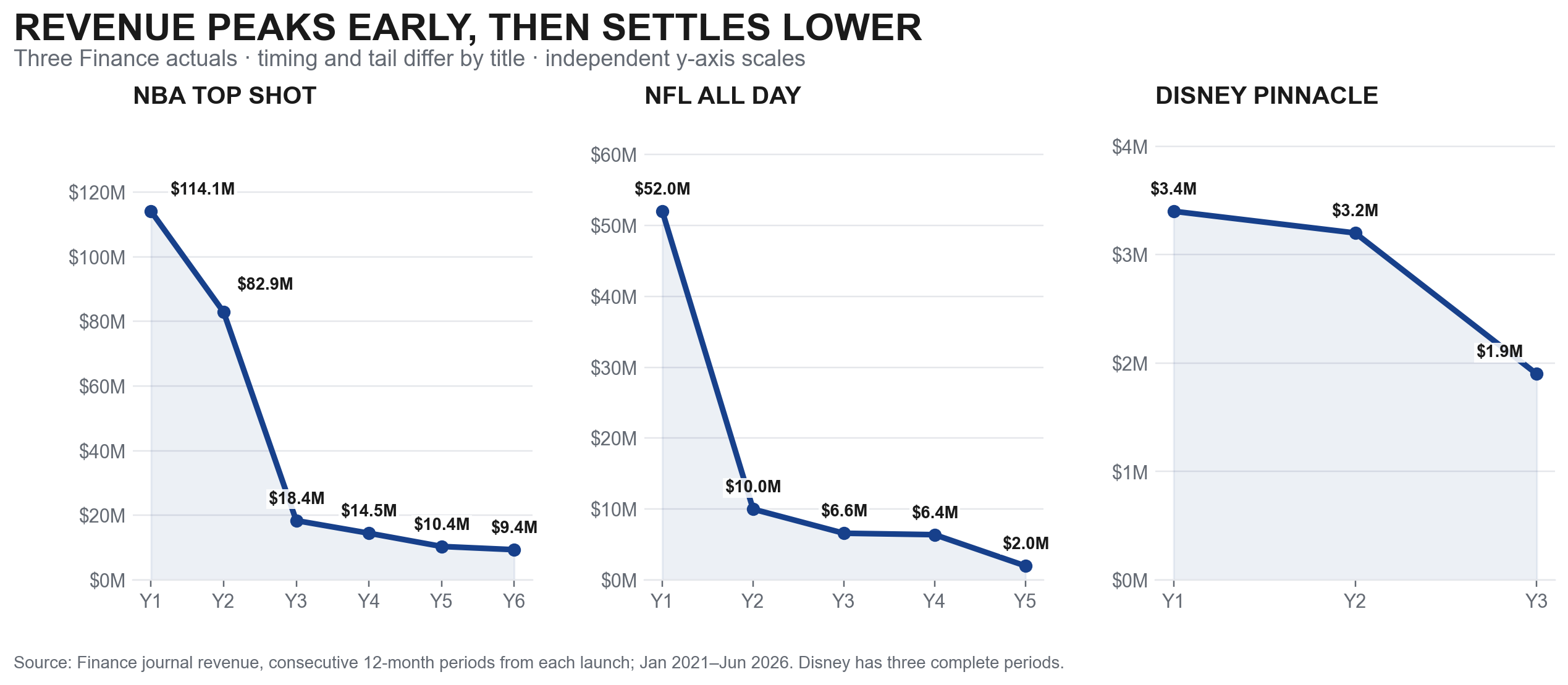
Roham and the Finance team reviewed journal revenue by product from January 2021 through June 2026. They organized each title into consecutive twelve-month periods from launch. The three products have different magnitudes and different paths, but they share one planning fact: revenue peaks early and settles at a lower level.
 Enlarge
NBA Top Shot produced USD 114.1M in its first twelve months, USD 82.9M in its second, and then settled into an approximately USD 10–14M annual range. NFL All Day moved from USD 52.0M to USD 10.0M and then approximately USD 6–10M before the later rights and hiatus reset. Disney Pinnacle, the only fully post-mania launch in the set, moved from USD 3.4M to USD 3.2M and then USD 1.9M.
Three titles establish a planning prior, not category physics. The data does not prove that every future title must follow the same path. It does show that underwriting a flat or permanently growing revenue line would ignore Dapper's own history.
Finance converts the evidence into a planning curve
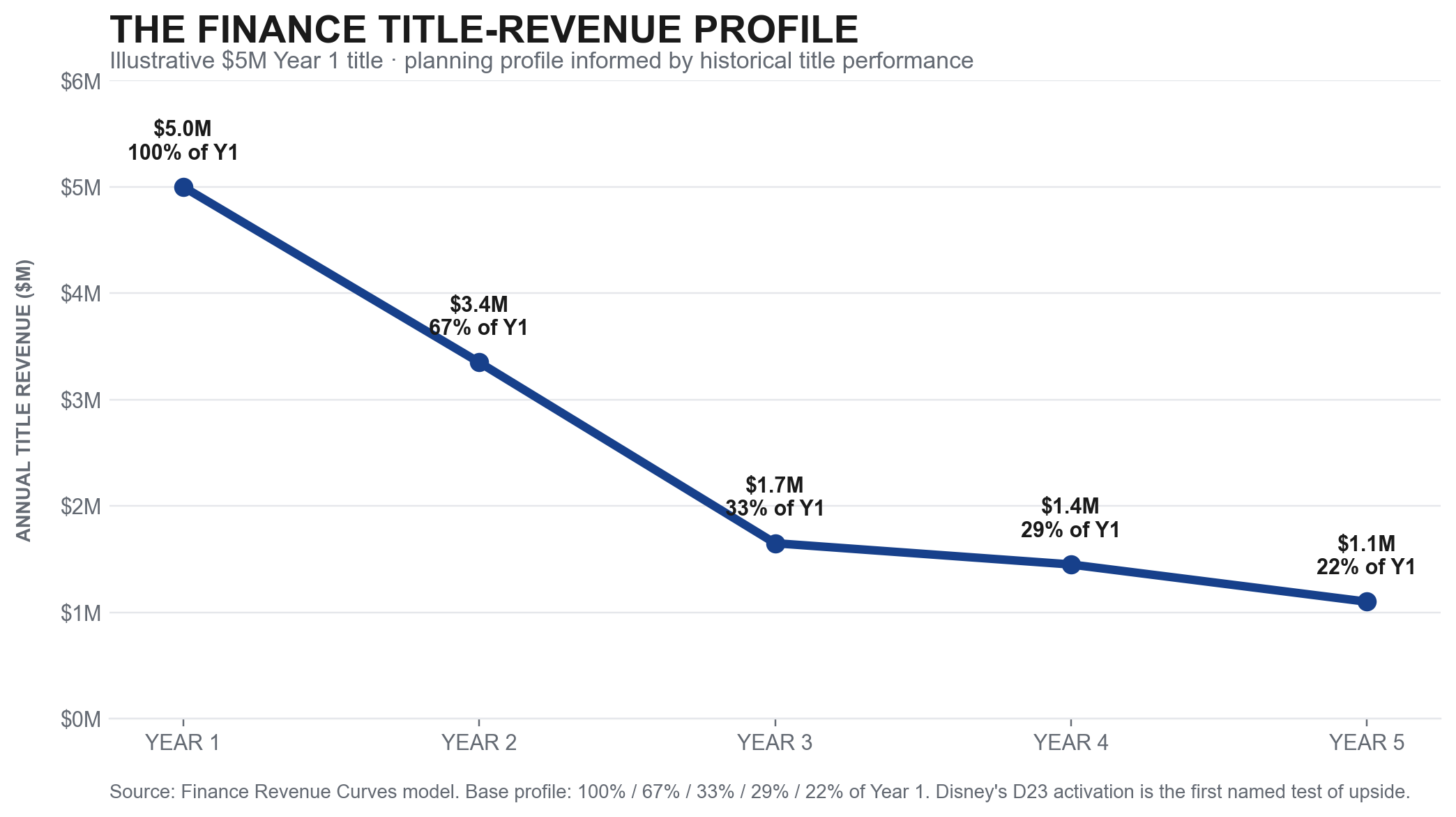
Finance's base new-title profile is 100% / 67% / 33% / 29% / 22% of launch-year revenue. For a representative title that produces USD 5.0M in year one, the model carries USD 3.35M in year two, USD 1.65M in year three, USD 1.45M in year four, and USD 1.10M in year five.
 Enlarge
The curve is conservative relative to the launch spikes in NBA and NFL and optimistic relative to some of their later declines. Disney provides the strongest post-mania support. We use the curve as the base case while trying to improve it. The Disney D23 activation is the first named test of whether stronger distribution, trading, and live operations can change the path.
Launch cadence fills the decline
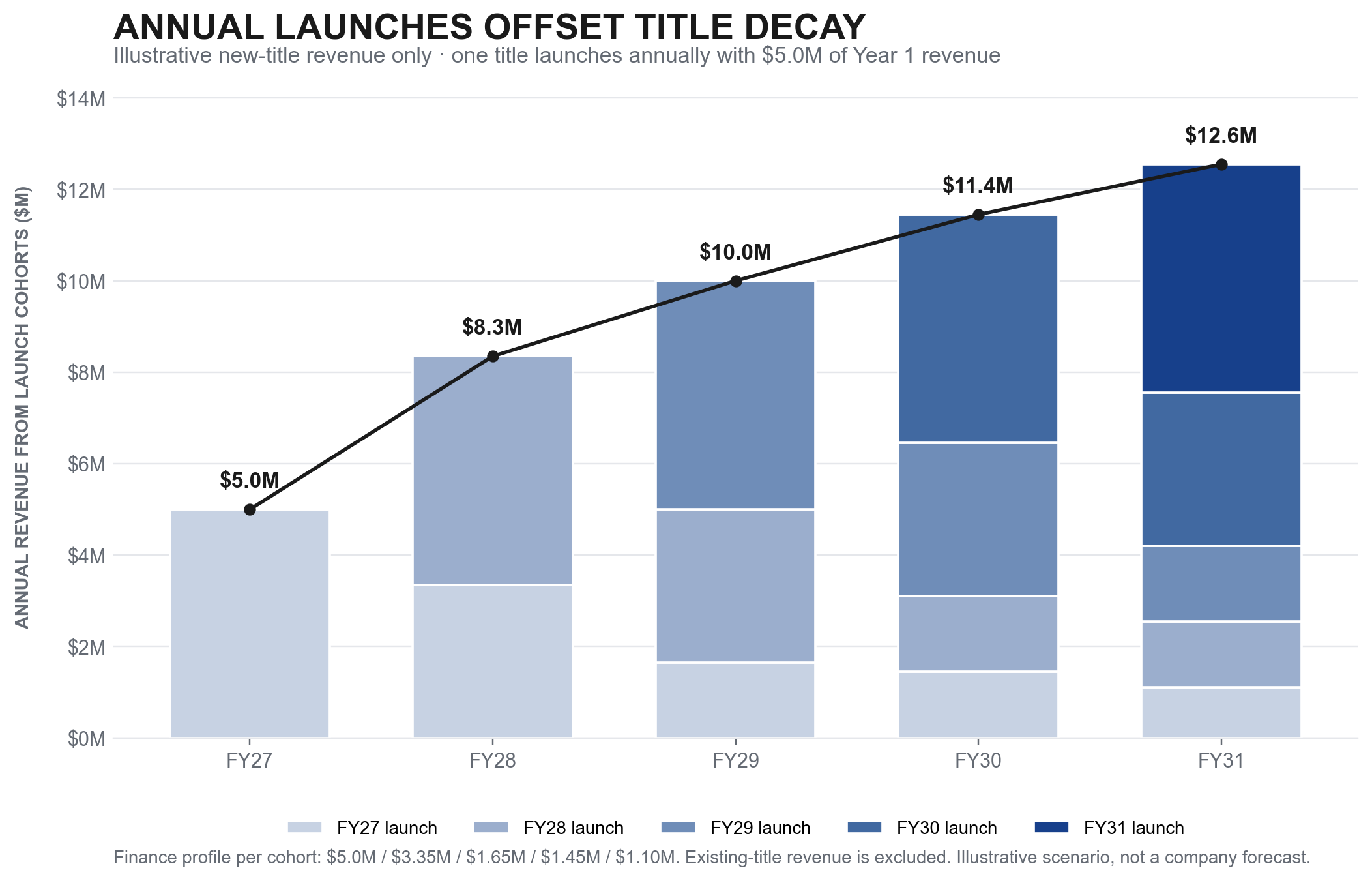
The strategy does not assume that a single title grows forever. It launches the next title before the prior title reaches its tail. The new cohort fills part of the decline from the older cohorts, while their remaining collectors continue to contribute revenue.
 Enlarge
The exhibit isolates the mechanism. It launches one representative USD 5.0M title each year and applies Finance's five-year curve to every cohort. Annual revenue from those launch cohorts rises from USD 5.00M to USD 12.55M by fiscal 2031 even though each title declines. Existing-title revenue is excluded. This is an illustration of the arithmetic, not a company forecast.
If launches stop, the stacked revenue falls as the existing cohorts age. The portfolio raises the floor only if Dapper keeps using the shared platform.
The tail must govern the cost
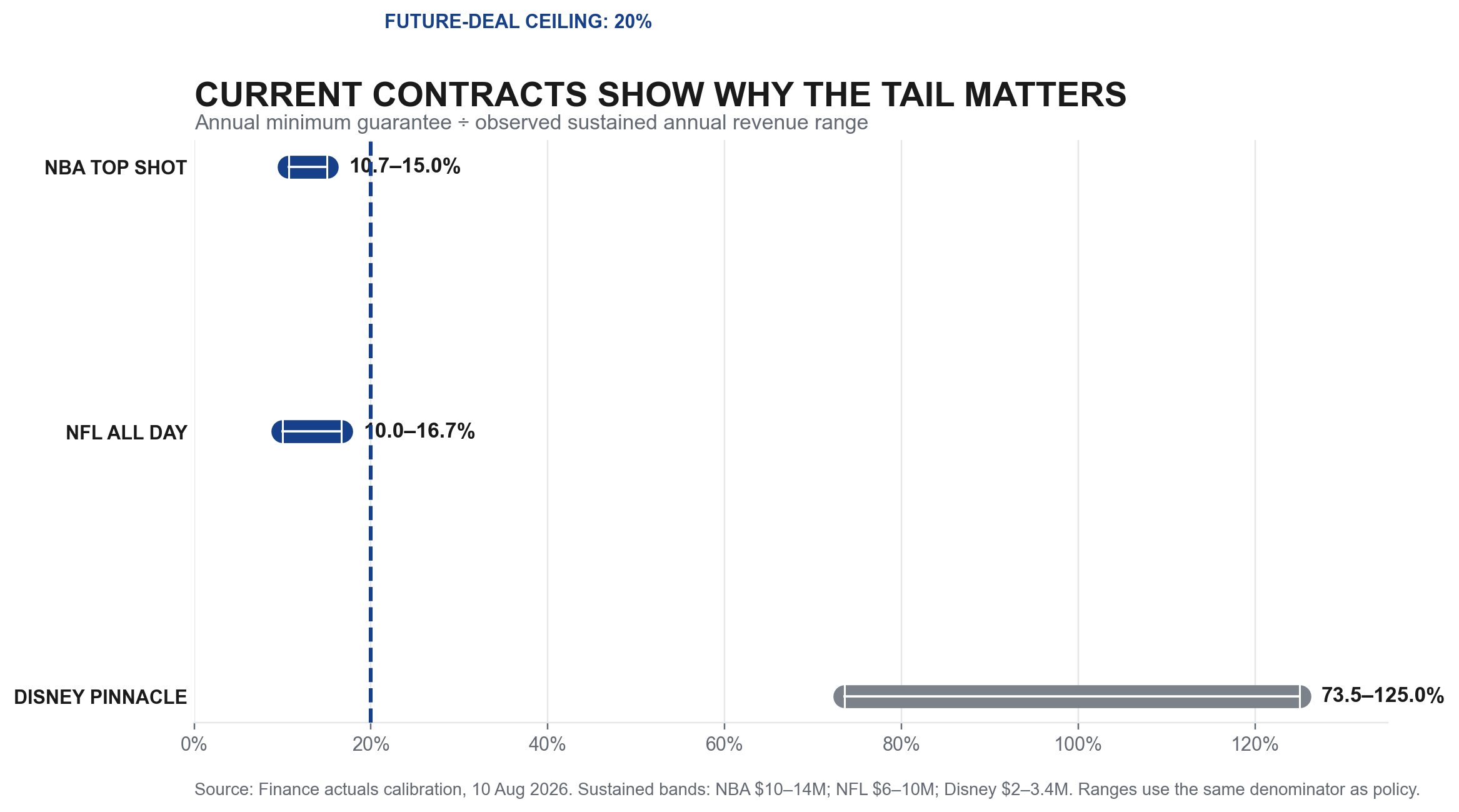
The launch spike cannot support a flat multi-year cost structure. Minimum guarantees, team size, content production, and marketing must be sized to sustained revenue and step down as the title decays.
 Enlarge
The sports agreements require two rights payments, not one. NBA and NBPA together cost USD 3.0M annually, approximately 21.4–30.0% of NBA Top Shot's observed sustained revenue range. NFL and NFLPA together cost USD 2.0M annually, approximately 20.0–33.3% of NFL All Day's observed sustained range. Disney's USD 2.5M is approximately 73.5–125.0% of its observed sustained range. Disney remains the extreme anti-pattern, but the complete sports-rights cost shows that NBA and NFL also sit at or above the future-deal ceiling.
The rule for future deals is an annual minimum guarantee at or below 20% of expected sustained revenue, with contractual step-downs as revenue declines. The first new Atlas title must also prove the fully loaded cost of launching and carrying another property.
The product model tests two new-IP cases on top of Finance's USD 12M Bear floor. Bear + New IP assumes a slow launch cadence, including one Large title in fiscal 2030. Revenue grows from USD 20.5M in fiscal 2027 to USD 37.9M in fiscal 2031, producing USD 31.3M of cumulative contribution before corporate allocation. Bull capacity asks what the platform and organization can support if rights, capital, and production capacity allow a much faster launch cadence. It reaches USD 67.2M of revenue and USD 26.7M of contribution before corporate allocation in fiscal 2031.
No pipeline title is signed, so these figures are scenarios.
The case turns on execution. The current business has to reduce its direct loss enough to cover the common platform. The first new title has to launch near the USD 0.5M cost assumption, with partner terms that still work after the launch spike fades. Then the organization has to prove it can repeat that launch without weakening NBA, NFL, or Disney, and without spending beyond the cash envelope. Those are the facts the next year must establish.
Bear + New IP deep dive
Finance Bear remains USD 12M of annual current-product revenue. Bear + New IP layers a conservative launch schedule on top of that floor; it is not the Finance Bear case itself. The scenario launches one Medium and one Small in fiscal 2027, one Medium in fiscal 2028 and fiscal 2029, one Medium, one Small, and one Large in fiscal 2030, then one Medium and one Small in fiscal 2031. The Large fiscal 2030 title assumes USD 10M of launch-year revenue and the same Finance decay curve used throughout the model.
| USD millions | fiscal 2027 | fiscal 2028 | fiscal 2029 | fiscal 2030 | fiscal 2031 |
|---|---|---|---|---|---|
| Total revenue | 20.5 | 22.7 | 23.2 | 38.0 | 37.9 |
| Contribution before corporate | 0.4 | 3.8 | 3.9 | 11.6 | 11.6 |
Five-year revenue is USD 142.2M; contribution before corporate is USD 31.3M. Modeled minimum-guarantee exposure is USD 10.95M and launch cost is USD 4.5M across fiscal 2026–31.
Bull capacity: what the platform could support
Bull capacity is not a growth rate applied to the conservative case. It is an operating-capacity test built from abstract launch slots. It assumes a partial Medium-equivalent program in fiscal 2026 and a second-half equivalent in fiscal 2027; two additional Medium launches in fiscal 2027; one Large and one extra-large launch in fiscal 2028; one Large and one Small in fiscal 2029; two Large and one Small in fiscal 2030; and two Large and one Medium in fiscal 2031.
The case assumes that rights close on schedule, guarantee cash is available, and Atlas and the operating team can support overlapping launches without weakening current products. It uses the aggressive staffing case: one full-time employee for Small, one and a half for Medium, two and a half for Large, and three for extra-large. It excludes cyclical upside from current products and all Ticketmaster revenue.
| USD millions | fiscal 2026 | fiscal 2027 | fiscal 2028 | fiscal 2029 | fiscal 2030 | fiscal 2031 |
|---|---|---|---|---|---|---|
| Total revenue | 19.5 | 26.2 | 46.2 | 47.1 | 57.0 | 67.2 |
| Contribution before corporate | — | 2.3 | 16.0 | 16.6 | 21.7 | 26.7 |
Five-year fiscal 2027–31 revenue is USD 243.6M; contribution before corporate is USD 83.3M.
The case represents fourteen launch equivalents across fiscal 2026–31. It requires USD 25.83M of modeled minimum-guarantee exposure and USD 7.0M of launch cost before title teams, marketing, royalties, and platform cost. By fiscal 2031, its aggressive staffing case carries USD 5.2M of annual title-team cost before platform and corporate allocation. Bear + New IP carries USD 2.7M under conservative staffing. Loaded role cost remains an assumption.
One operating system for collectibles growth
Finance's Bear case starts at USD 12.0M of current-product revenue: USD 10.0M from NBA Top Shot, USD 2.0M from Disney Pinnacle, and zero from NFL ALL DAY. The growth plan is not to build a separate strategy, team, and operating system for every property. It is to build one repeatable system for acquiring, reactivating, and retaining collectors, then deploy it across NBA, Disney, NFL, and every new title launched on Atlas.
The system begins with three customer groups: current active collectors, dormant collectors who have purchased before, and net-new paid buyers. Each group has different economics. Current collectors need reasons to buy again. Dormant collectors need a relevant event and a personalized path back. New buyers need low-friction entry, a clear first purchase, and a reason to return. We will measure the groups separately and deduplicate them before any revenue enters a case.
Scarcity, live events, free-to-play, guest checkout, trading, collection progression, and partner distribution are parts of this system. They are not separate revenue pools. Scarcity creates the event. Distribution creates reach. Guest checkout and free-to-play reduce entry friction. Trading and progression create the second action. The economic result appears only when those mechanisms produce paid conversion, repeat purchasing, and positive contribution.
This is where the platform rebuild changes the model. Segmentation, campaign orchestration, collection state, trading, progression, attribution, and live operations should be built once and reused across properties. Each title still needs its own rights, content, creative work, and partner plan. It should not need a new backend, a new growth stack, or a separate team recreating the same operating capabilities. The first new Atlas title must prove the fully loaded incremental cost, but the operating direction is clear: more properties should increase utilization of the shared system faster than they increase fixed cost.
NBA is the first deployment because it has the deepest measured base, known customer identities, and a calendar management controls. The reviewed base case identifies USD 4.78M of incremental commercial value relative to NBA's USD 10.0M Bear endpoint. USD 4.44M comes from restoring value in the active and dormant installed base; USD 0.34M comes from NBA-app acquisition. This is a commercial proxy, not recognized revenue. High-value reactivators produce 67.6% of modeled ninety-day value, so the first test is whether the program produces positive recognized contribution without extrapolating that cohort's behavior to everyone else.
Disney uses the same system through different distribution. D23, Disney-owned channels, and Marvel content can test whether partner reach becomes paid acquisition and repeat collecting. The proposed amendment would reduce the annual minimum guarantee from USD 2.5M to USD 1.25M in each of 2027, 2028, and 2029, reduce the annual marketing commitment from USD 1.25M to USD 0.30M, and add Marvel access. Those terms are agreed in principle and not approved. No Disney or Marvel upside enters the forecast before the agreement and the customer economics are documented.
NFL is the same operating system behind a rights-dependent gate. A full player-content relaunch supports a USD 3.36M base commercial proxy above the zero Bear endpoint if viable NFLPA economics return. A rights-constrained team-mark and ticket-stub alternative supports a smaller USD 0.83M base, subject to legal confirmation and positive unit contribution. The two paths are mutually exclusive. Dapper will not spend into a full relaunch until signed rights economics support positive downside contribution.
The next proofs
The strategy now has dates. Disney's first read begins at D23. The event opens the morning after this meeting. We will read the cohort after seven days, thirty days, and ninety days. The question is not whether people claim a free item. It is whether they become paying collectors and return.
NBA Top Shot's next test is Run It Back on August 26, followed by the season-opening program. Top Shot has the deepest installed base and the best evidence that scarce content can reactivate dormant collectors. It also has an aging customer base and weak new-buyer intake. The program has to solve both.
By September 15, counsel should have the abstract rights map for the new-title pipeline. By September 30, we should decide whether FIFA's 2030 calendar is worth pursuing now or whether the extra-large slot remains available for Formula 1 later. These dates turn the pipeline from a list of names into an operating plan.
Dapper VIP
Peak Money becomes Dapper VIP through a rebrand. Existing accounts, balances, and financial capabilities continue under the Dapper brand. This turns consumer finance from a separate bet into a tool for the customers who matter most to collectibles.
The product is simple. Dapper VIP costs USD 499 a year and includes a virtual card. Dapper VIP XL costs USD 999 and adds a metal card. Both tiers work across every Dapper property. The benefits can include points, earlier access to drops, real-world experiences, Dapper VIP Earn, and Dapper VIP Win. The card is part of the membership; it is not the business by itself.
The direct economics come from membership fees. Until an issuer commits an interchange rate in writing, we give ourselves no credit for swipe revenue. The program uses shared capacity and adds no dedicated team. At the low end, 403 members produce about USD 0.21 million of annual fees against USD 0.31 million of recurring cost, a recurring loss of about USD 0.09 million. The Management case reaches 822 members, about USD 0.43 million of fees, and approximately USD 0.06 million of positive recurring contribution. At 1,972 members, the program produces about USD 1.02 million of fees and approximately USD 0.47 million of recurring contribution.
The fixed cost is what makes the program legible. Wirex costs USD 20,000 a month. Cash benefits stay below 20% of fees. Member operations, inactive-card fees, and metal cards scale with participation. With no dedicated team, recurring break-even is about 654 paid members, or 1.85% of the active buyer base.
The strategic case is retention. In the Management case, the people who convert to paid membership account for USD 42.78 million of trailing-twelve-month gross merchandise value. Membership fees cover recurring cost without giving credit for retention. The remaining first-year gap is about USD 0.14 million of launch cost. Preserving 3.3% of the paid cohort's activity at a 10% contribution margin closes that gap. We will not book that benefit in advance. The pilot has to show that paid members renew, spend, and collect across more than one Dapper property at a higher rate than comparable non-members.
The immediate request is limited to USD 0.15 million of pre-launch work through September 30, funded inside the existing plan. That work covers executable issuer terms, final benefits and rewards budgets, the card launch plan, monthly cash through December 2027, and the measurement design. It does not authorize an issuer signature or a long-term liability.
Ninety days after launch, the program continues only if it has at least 400 paid members and is adding them fast enough to reach the 654-member recurring break-even within a year. At least a quarter of the 85 highest-value collectors must convert, benefits must stay within the approved share of fees, and paid members must show better renewal and cross-property activity than the control group. At twelve months, the program scales only if direct contribution plus measured retention contribution is positive. Rain becomes relevant later, when actual swipe volume and a written net take justify giving up part of the membership fee.
The pipeline
The sourced 10-Aug pipeline contains 16 core opportunities and a broader bench. None is signed.
Core pipeline
| Property | Indicative Y1 | Stage | Primary gate |
|---|---|---|---|
| MLB + MLBPA | USD 10M | Engaged | Game-piece rights and build timing |
| AEW | USD 6M | Next up | Upper Deck scope/expiry |
| Marvel standalone | USD 3.5M | Relationship path | VeVe rights |
| Disney + F1 addendum | USD 2M | Near-term path | Addendum scope |
| College football | USD 12M | Not started | Four-party rights stack |
| FIFA / World Cup | USD 15M cyclical | Engaged, deferred | Rights and calendar |
| PGA Tour | USD 7M indicative | Engaged — initial meeting complete; one-pager next; no terms signed | Autograph through 2027; no group license |
| NHL + NHLPA | USD 9M indicative | Not started | Upper Deck / prior digital rights |
| NASCAR | USD 9M indicative | Not started | Rights and product design |
| MLS + MLSPA | USD 5.5M | Connections | Sorare and video rights |
| Paramount pilot | USD 7M | Not started | Franchise selection and terms |
| Sanrio | USD 3.5M | Re-engage | New terms |
| ATP | USD 4M | Not started | Likeness/litigation |
| Public Domain Baseball | USD 4M | No rights holder | Trademark/estate clearance |
| Public-domain characters | USD 3M | No rights holder | Modern-version/trademark clearance |
| F1 standalone | USD 15M | Re-engage | Timing and commercial model |
The later 14-title appendix uses different names, title sizes, and minimum guarantees, and it reintroduces WNBA after the August 10 pipeline removed it. Roham, business development, and Finance must settle on one pipeline before any of these titles enters a forecast.
Near-term deep dives
MLB has a real product and a credible rights-separation argument: game-piece rights can be distinct from trading-card exclusivity, supported by MLB Showdown precedent. The legal gate remains open, and game build pushes revenue later than signature.
PGA Tour has management access and event-activation interest, but no current group-license structure and an Autograph relationship through 2027. The near-term lane is individual players and event activation, not a Tour-wide Top Shot analogue.
These properties demonstrate that the pipeline is active. They do not justify booking revenue before rights, terms, build, and distribution are underwritten.
Management perspective
The current business is real and valuable, but the available financial record does not support a claim that profitability has arrived. The path depends on executed cost reduction, disciplined partner economics, and additional contribution from current and future titles.
The new-title strategy is the clearest path to a financeable collectibles business because it uses a platform we have already paid for to create new revenue without requiring every title to become a flagship. Bear + New IP works before corporate allocation without an extra-large title. Bull capacity can become large, but only with substantial guarantee cash, operating discipline, and repeated execution.
The board does not need to believe a USD 67.2M capacity case. It needs to believe we can make one investment at a time, measure it honestly, and stop when the economics fail. The first new Atlas title, Disney's recognized D23 cohort economics, NBA's Run It Back results, and a Ticketmaster/Live Nation partner-distribution pilot are among the next proofs.
The core proposition is straightforward: Dapper has paid for the platform and learned how digital collectible economies behave. The next value-creation phase depends on converting those sunk assets and lessons into repeatable, contribution-positive launches while protecting cash. The arithmetic and the conditions are now visible. The next four proofs will tell us whether the conversion is underway.
Board discussion
The board is not being asked to adopt the bear revenue case or any hypothetical high-revenue case as management's target. Management is using Bear to set the company's cost envelope while continuing to pursue higher revenue.
Management is proceeding with the immediate cost actions described above. The open board decision is whether the CryptoKitties and Miquela work shuts down or continues through an independently funded spinout. Dapper funding ends under either path.
Management will return shortly with the detailed revenue-scaled operating plan for the collectibles team. The board can hold us to the year-end cost targets, the quality of each transition, and the evidence produced by the growth plan.
Appendix: title economics
Central title assumptions
| Assumption | Value |
|---|---|
| Launch cost | USD 0.5M |
| Small title team | 1.0 full-time employee / USD 0.2M |
| Medium title team | 1.5 full-time employee / USD 0.3M |
| Large title team | 3.0 full-time employees conservative / 2.5 aggressive |
| Extra-large title team | 4.0 full-time employees conservative / 3.0 aggressive |
| Marketing | 9% of revenue |
| Effective royalty | 15% of revenue |
| Revenue curve | 100% / 67% / 33% / 29% / 22% |
| Small Year 1 revenue | USD 3.5M |
| Medium Year 1 revenue | USD 5.0M |
| Large Year 1 revenue | USD 10.0M |
| Extra-large Year 1 revenue | USD 15.0M |
The revenue curve is a planning assumption, not proven category physics. It is intentionally conservative relative to launch spikes and optimistic relative to some year-two sports actuals. Disney provides the strongest post-mania support.
Five-year title economics
| Tier | Staffing case | Revenue | Direct cost | Contribution | Margin |
|---|---|---|---|---|---|
| Small | 1.0 full-time employee | USD 8.79M | USD 4.55M | USD 4.23M | 48.2% |
| Medium | 1.5 full-time employees | USD 12.55M | USD 7.01M | USD 5.54M | 44.2% |
| Large | 3.0 full-time employees conservative | USD 25.10M | USD 13.10M | USD 12.00M | 47.8% |
| Extra-large | 4.0 full-time employees conservative | USD 37.65M | USD 20.02M | USD 17.63M | 46.8% |
These figures use additive minimum-guarantee and royalty treatment.
Tail economics
Small-title contribution moves from USD 1.71M in year one to USD 0.21M in year five. Medium moves from USD 2.25M to USD 0.29M. Large and extra-large titles remain positive. These results use the conservative end of the Large and extra-large staffing ranges and give no further credit for shared-marketplace efficiency or retirement.